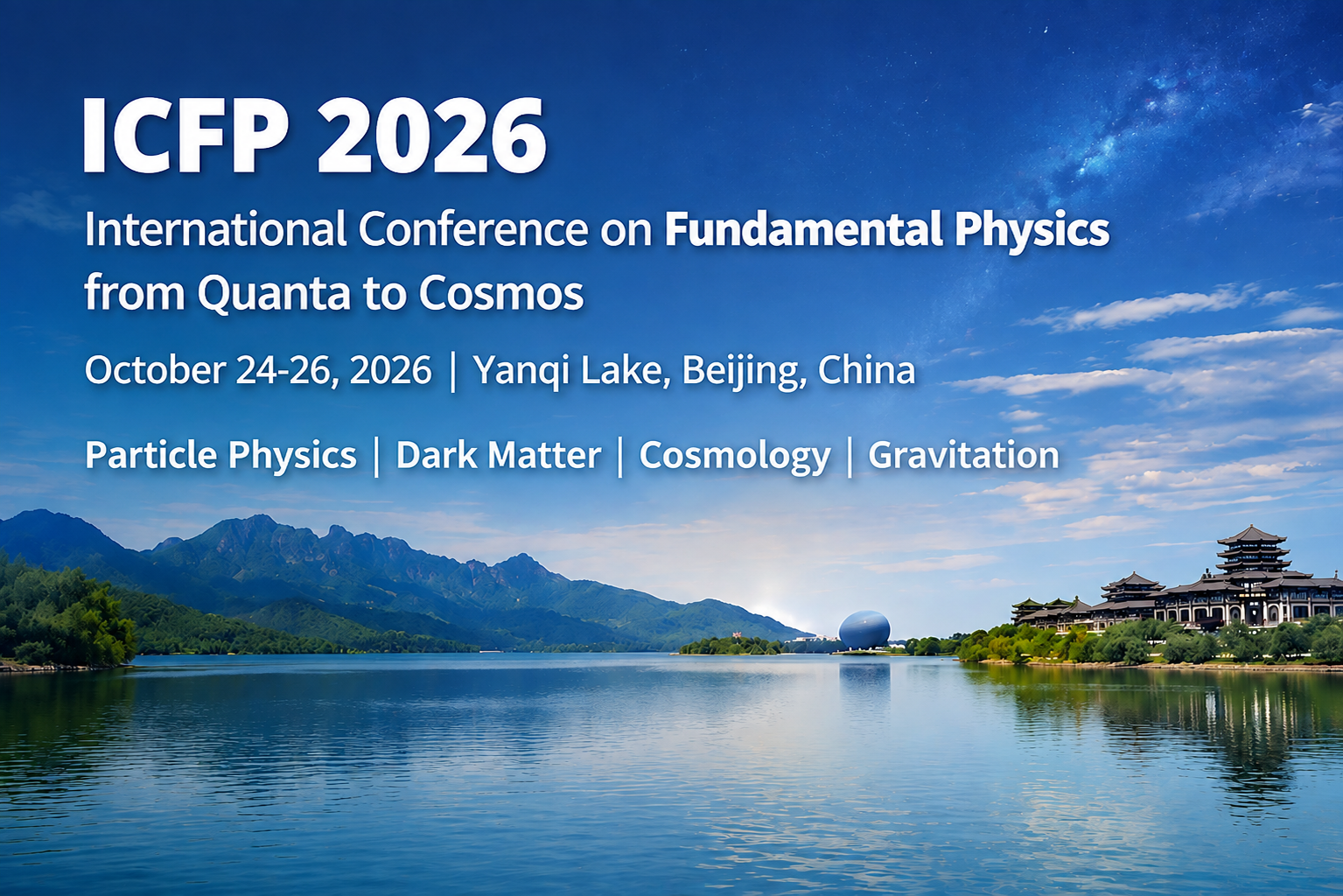
The International Conference on Fundamental Physics from Quanta to Cosmos (ICFP 2026)

→ Asia/Shanghai
Description

We are pleased to announce a significant evolution of the long-standing ICFP conference series. Since its first meeting in 2001 in Zhangjiajie, China, the International Conference on Flavor Physics (ICFP) has served as an important forum for the high-energy physics community. It has successfully fostered deep collaboration on the fundamental problem of flavor—the origins of fermion masses, mixing, CP violation, and leptonic and hadronic physics—while emphasizing the interplay between theory and experiment through the eras of the B factories, neutrino experiments, and the LHC. Following conferences in Seoul, Korea (2003), Taiwan, China (2005), Beijing, China (2007), and Hanoi, Vietnam (2009), and its subsequent expansion into the International Conference on Flavor Physics and Cosmo-physics (2012, Weihai, China), this series has continued to evolve in order to address frontier problems in fundamental physics.

To reflect the increasingly interconnected and interdisciplinary nature of modern fundamental physics, and to foster broader collaboration, the series is now rebranded as the International Conference on Fundamental Physics from Quanta to Cosmos (ICFP). We are proud to retain the acronym while embracing a significantly expanded scientific scope. The new ICFP will serve as a unified platform for exploring open questions related to the evolution of the Universe.

ICFP 2026 will be held from October 24 to 26 at the scenic lakeside of Yanqi Lake, Beijing. The conference program will comprehensively cover particle physics, particle cosmology, gravitational physics, and the dark side of the Universe. We warmly invite researchers from around the world to join us for this exciting conference.

Confirmed Plenary Speakers:

  • Xiaojun Bi (Institute of High Energy Physics, Chinese Academy of Sciences)
  • Haiyang Cheng (Institute of Physics, Academia Sinica)
  • Eung Jin Chun (Korea Institute for Advanced Study)
  • Yuanning Gao (Peking University)
  • Xiaogang He (Shanghai Jiao Tong University)
  • Alejandro Ibarra (Technical University of Munich)
  • Shaaban Khalil (Zewail City of Science and Technology)
  • Pyungwon Ko (Korea Institute for Advanced Study)
  • Bum-Hoon Lee (Sogang University)
  • Di Li (Tsinghua University)
  • Haibo Li (Institute of High Energy Physics, Chinese Academy of Sciences)
  • Tipei Li (Tsinghua University)
  • Zuotang Liang (Shandong University)
  • Jianxin Lu (University of Science and Technology of China)
  • Youjun Lu (University of Chinese Academy of Sciences)
  • Shi Pi (Institute of Theoretical Physics, Chinese Academy of Sciences)
  • Joshua Ruderman (New York University)
  • Naoki Seto (Kyoto University)
  • Stefano Vitale (University of Trento)
  • Junichi Yokoyama (University of Tokyo)
  • Qian Yue (Tsinghua University)
  • Zeyuan Yu (Institute of High Energy Physics, Chinese Academy of Sciences)
  • Xinmin Zhang (Institute of High Energy Physics, Chinese Academy of Sciences)
  • Yangheng Zheng (University of Chinese Academy of Sciences)

Conference Dates: October 24–26, 2026 (registration on October 23; departure on October 27)

Venue: Qihu Hotel, No. 11 Yanxiu Road, Huaibei Town, Huairou District, Beijing, China

Registration Fees: RMB 2000 for faculty/postdocs; RMB 1500 for students.

Host Institution: Institute of Theoretical Physics, Chinese Academy of Sciences (ITP-CAS)

Co-organizers: International Centre for Theoretical Physics Asia-Pacific, University of Chinese Academy of Sciences (ICTP-AP), and the School of Fundamental Physics and Mathematical Sciences, Hangzhou Institute for Advanced Study, University of Chinese Academy of Sciences (HIAS)

International Organizing Committee: 

  • Ronggen Cai (Ningbo University)
  • Zhen Cao (Institute of High Energy Physics, Chinese Academy of Sciences)
  • Haiyang Cheng (Institute of Physics, Academia Sinica)
  • John Ellis (King’s College London)
  • Yuanning Gao (Peking University)
  • Tao Han (University of Pittsburgh)
  • Xiaogang He (Shanghai Jiao Tong University)
  • Pyungwon Ko (Korea Institute for Advanced Study)
  • Yuping Kuang (Tsinghua University)
  • Bum-Hoon Lee (Sogang University)
  • Tipei Li (Tsinghua University)
  • Zuotang Liang (Shandong University)
  • Jianxin Lu (University of Science and Technology of China)
  • Mingxing Luo (Beijing Computational Science Research Center)
  • Remo Ruffini (International Center for Relativistic Astrophysics Network)
  • Mairi Sakellariadou (King’s College London)
  • Misao Sasaki (Asia Pacific Center for Theoretical Physics)
  • Qaisar Shafi (University of Delaware)
  • Stefano Vitale (University of Trento)
  • Yifang Wang (Institute of High Energy Physics, Chinese Academy of Sciences)
  • Yueliang Wu (Institute of Theoretical Physics, Chinese Academy of Sciences)
  • Xinmin Zhang (Institute of High Energy Physics, Chinese Academy of Sciences)
  • Gang Zhao (National Astronomical Observatories, Chinese Academy of Sciences)
  • Yangheng Zheng (University of Chinese Academy of Sciences)
  • Bingsong Zou (Tsinghua University)

Local Organizing Committee:

       ITP-CAS — Zongkuan Guo, Shi Pi, Ningqiang Song, Shaojiang Wang, Jianghao Yu, Yufeng Zhou;

       HIAS — Chaoqiang Geng, Chiawei Liu, Chen Sun, Yeling Zhou;

       ICTP-AP — Xiaoyong Chu, Huaike Guo, Jun Nian.

Contact Information

       Contact Person: Ms. Shanshan Gao

       Email: gaoshanshan@itp.ac.cn

       Phone: +86-010-62582370

This conference has been funded by the following institutions/centers: the Institute of Theoretical Physics, Chinese Academy of Sciences; the Peng Huanwu Innovation Research Center for Theoretical Physics; the Center for Gravitational Wave Physics and Cosmology; the International Centre for Theoretical Physics Asia‑Pacific, University of Chinese Academy of Sciences (ICTP‑AP); and the School of Fundamental Physics and Mathematical Sciences, Hangzhou Institute for Advanced Study.

Participants
  • Ajay Kaladharan
  • Arnav Chauhan
  • Ayush Hazarika
  • Baisong Xie
  • Bo-Qiang Lu
  • Bum-Hoon Lee
  • Chang Lei
  • changkai zeng
  • Chao Zhang
  • Chao-Qiang Geng
  • Chen Sun
  • Chengji Zou
  • ChengJun Fang
  • Chunhui Liu
  • Ci Zhuang
  • Cong Feng Qiao
  • Da Huang
  • Da Liu
  • dandan Cui
  • DANIEL ELOZONACHUKWU NLIAM
  • Di Zhang
  • duowen li
  • EMMANUEL UDOCHUKWU PAT-ASADU
  • Ensuo Ma
  • Eung Jin Chun
  • Fanrong Xu
  • Fanxiu Liu
  • Fanzi Meng
  • FARUK ANJUWON ANFELA
  • Fei Huang
  • Gaoping Long
  • GERALDINE UCHE ONUORAH
  • Guanghao Zhang
  • Guanhao Sun
  • Guohao Li
  • Hai Yang Cheng
  • Hai-Bo Li
  • Haihong Jia
  • Haiyuan Feng
  • Hansong Zhang
  • Hao Xu
  • Hao Xu
  • Hao Yu Luo
  • Haomin Rao
  • Haoran Xu
  • Haorong Wu
  • He Liu
  • He Wang
  • Hong-Bo Jin
  • Hongguang Liu
  • Houbing Jiang
  • Huaike Guo
  • James Oni Kayode
  • Jia-Jun Wu
  • Jia-Xi Feng
  • Jiang-Hao Yu
  • Jiankang Sun
  • JIANXIN LU
  • Jianxiong Wang
  • jiayi liusun
  • Jiejin Zhao
  • Jinyuan Liu
  • Jiyuan Liu
  • Jun Nian
  • Jun Zhang
  • Kun Peng Chen
  • Liang Li
  • Lu Yin
  • Mai Qiao
  • Meiwen Yang
  • Meng Xu
  • MIN ZHANG
  • MUHAMMAD SHAHZAD
  • Murat Abdughani
  • Naili Cui
  • Naoki Seto
  • Nicholovich Rose
  • Ningqiang Song
  • Pyungwon Ko
  • Qaisar Shafi
  • Qi Chen
  • Qian Yue
  • Qingdi Wang
  • Qingyang Wang
  • Quanyu Wang
  • Rafia Waqar
  • Rahim Moradi
  • Rhitaja Sengupta
  • Ruhan Rao
  • Rui Zou
  • Ruoxuan Yu
  • Sasha Tomalak
  • Saurabh K Shukla
  • Shaaban Khalil
  • Shan-Shan Gao
  • Shao-Jiang Wang
  • Shaoqi Hou
  • Shi Pi
  • Shi-Bei Kong
  • Shoaib Aziz
  • Shou-shan Bao
  • Teng Ma
  • Vigilante di Risi
  • Vishnu Rajagopal
  • Waqas Ahmed
  • Wei Chao
  • Wei Dongdong
  • Wen-Hao Jiang
  • Wenbin Zhao
  • Xi-Jie Zhan
  • Xia Tang
  • Xiao-Gang He
  • Xiaofeng YANG
  • Xiaojun Bi
  • Xiaoyong Chu
  • xinxin qi
  • Xiu-hui Tan
  • Xu-Hui Jiang
  • Yan-Heng Yu
  • Yanda Wu
  • Yangheng Zheng
  • yaozhong xin
  • Ye-Ling Zhou
  • Yinghui Liu
  • YISU WU
  • Yong Tang
  • Yong Xiao
  • Yong-Liang Ma
  • Youjun Lu
  • Yu Wang
  • Yu-Ke Wang
  • Yuan-Jie Li
  • Yuanning Gao
  • Yue-Lin Sming Tsai
  • Yun-Long Zhang
  • Yuu-Feng Zhou
  • Zhiheng HUAI
  • Zi-Qiang Chen
  • Zixuan Wang
  • Zixuan Xu
  • ziyi Zhou
  • Zong-Kuan Guo
  • Álvaro Diaz Carmona
  • 华平 向
  • 喆伟 殷
  • 培元 徐
  • 李 烜
  • 泽源 于
  • 洋 韩
  • 玉军 董
  • 龙 阮
    • 08:45 → 09:00
      Plenary Sessions: Opening Ceremony
    • 09:00 → 10:40
      Plenary Sessions: Particle Physics and BSM
      • 09:00
        The recent status and future plan for CDEX and CJPL 25m
        Speaker: Qian Yue
      • 09:25
        Highlights from LHAASO and implications on cosmic ray physics and new physics 25m
        Speaker: Xiaojun Bi
      • 09:50
        A Model of GeV-Scale Dark Matter Stabilized by Baryon Number Conservation 25m
        Speaker: Alejandro Ibarra
      • 10:15
        Phases of Particle Dark Matter 25m
        Speaker: Joshua T. Ruderman
    • 10:40 → 11:00
      Break 20m
    • 11:00 → 12:15
      Plenary Sessions: Particle Physics and BSM
      • 11:00
        Leptogenesis Determined by Low Energy Parameters 25m
        Speaker: Xiao-Gang He
      • 11:25
        Spontaneous leptogenesis driven by majoron 25m
        Speaker: Eung Jin Chun
      • 11:50
        B-L Supersymmetric Extension of the Standard Model (BLSSM) 25m
        Speaker: Shaaban Khalil
    • 12:30 → 14:00
      Lunch 1h 30m
    • 14:00 → 15:00
      Gravitational Wave Physics (Room A)
      • 14:00
        Little Red Dots: The Wandering Black Holes 20m
        Speaker: Prof. Yu Wang (ICTP)
      • 14:20
        The Generation and Detection of Chiral Gravitational Wave Backgrounds 20m

        Chiral gravitational wave backgrounds are predicted in many well-motivated mechanisms. We investigate the detection of Chiral GWBs using a network of detectors under arbitrary configurations. We also propose a dipole pulsar timing array, which demonstrates sensitivity to Chiral gravitational wave backgrounds from the nanohertz to microhertz regime.

        Speaker: Yun-Long Zhang (NAOC(National Astronomical Observatories, CAS))
      • 14:40
        Silk damping in induced gravitational waves: a novel probe of new physics 20m

        The early universe is a natural laboratory for high-energy physics, and gravitational waves, as direct probes of this epoch, inherently carry rich information related to high-energy physics. Silk damping, resulting from dissipation in the cosmic fluid, is a significant physical phenomenon in the early universe. In this talk, I will introduce our first study on Silk damping in induced gravitational waves. Silk damping notably suppresses the spectrum of induced gravitational waves on scales comparable to a diffusion scale at the decoupling of weakly-interacting particles. This characteristic suppression offers a novel and general observable for detecting the underlying particle interaction, especially for those mediated by heavy gauge bosons beyond the Standard Model. We anticipate that pulsar timing arrays are sensitive to gauge bosons with masses ∼ 10³−10⁴ GeV, while space- and ground-based interferometers to those with masses ∼ 10⁷−10¹² GeV, leading to essential complements to traditional high-energy physics experiments.

        Speaker: Dr Yu Yan-Heng (HIAs, UCAS)
    • 14:00 → 15:00
      Gravity and Cosmology (Room C)
      • 14:00
        Cosmological Stasis and Its Phenomenological Implications 20m

        Cosmological stasis is a phenomenon in which multiple energy components with different equation-of-state parameters maintain constant abundances for an extended period despite the expansion of the universe. In this talk, I review how stasis arises and discuss the possible implications of this phenomenon in observations. These include the enhancement in the growth of matter density perturbations on small scales, and characteristic imprints in the stochastic gravitational-wave background.

        Speaker: Prof. Fei Huang (Anhui University of Science and Technology)
      • 14:20
        Local Cosmography from Causal Set Pixies 20m

        In causal set theory, spacetime is represented by a locally finite partially ordered set. The abundances of small combinatorial structures can be used to recover information about its continuum geometry. We study how chains and 2-pixies can be used to recover local cosmological quantities in four-dimensional, spatially flat FLRW spacetimes. For causal diamonds centered on a comoving observer, we calculate the symmetric abundances through fourth order in the proper duration and the difference between upward and downward 2-pixies through third order. Riemann normal expansions identify the geometric terms, and exact integration in conformal coordinates gives their coefficients. The symmetric counts determine combinations of the Hubble and deceleration parameters. The difference between upward and downward 2-pixies probes curvature evolution and gives access to the dimensionless third derivative of the scale factor, known as the cosmological jerk. We test the calculation with independent continuum integration and simulated causal sets, and study the inference using the full covariance of the counts. The tests separate geometric truncation error from sampling uncertainty and show the cost of including higher-order terms. The construction uses calibrated interval durations. Applying it within one causal set requires an intrinsic clock and a treatment of correlations between overlapping intervals.

        Speaker: He Liu (Tsinghua University)
      • 14:40
        Relational Scales and Hamiltonian Renormalization in Quantum Gravity 20m

        How should one define a renormalization scale when spacetime geometry itself is quantum and dynamical? I will discuss a relational formulation of coarse graining in which physical resolution and mode ordering are defined by dynamical geometric observables, while RG flow remains distinct from physical clock evolution.
        I will then present a Hamiltonian implementation using the non-perturbative functional renormalization group, where quantum fluctuations can modify the full momentum–velocity relation and the symplectic structure. Requiring consistent local evolution further constrains the effective Hamiltonian and provides a route from quantum-gravity dynamics to cosmological backgrounds, perturbations and observables.

        Speaker: Hongguang Liu (Westlake University)
    • 14:00 → 15:00
      Particle Phenomenology (Room B)
      • 14:00
        Violation and Restoration of Probability Positivity in Perturbative Quantum Field Theory 20m

        We address the long-standing problem of negative decay and production rates in perturbative QCD
        for exclusive processes by proposing amplitude-level NRQCD factorization as a systematic prescription.
        Building on this, we present the first complete next-to-next-to-leading-order (NNLO) QCD correction to
        the decay $J/\psi \to 3\gamma$. The resulting partial width,
        $\Gamma(J/\psi \to 3\gamma) = 0.96^{+4.32}_{-0.13}$ eV, combines this NNLO contribution with
        the known up to $\mathcal{O}(\alpha_s v^2)$ relativistic correction and shows markedly improved
        agreement with the high-precision BESIII measurement. In the same way,
        $\Gamma(\Upsilon \to 3\gamma) = 0.0086^{+0.0028}_{-0.0006}$ eV is obtained.

        From a first-principles perspective, it is clear that for exclusive processes, taking the complete
        modulus squared of the full amplitude is precisely the proper definition of the probability
        distribution and guarantees its manifest positivity. This makes the amplitude-level prescription
        the natural and physically motivated scheme. For inclusive processes, however, one is forced to
        abandon the full modulus square due to the need to cancel infrared divergences at the level of
        the truncated squared amplitude.

        Based on arXiv:2603.26199.

        Speaker: Bin Gong
      • 14:20
        Radiative corrections to neutron and inverse beta decay at low energies 20m

        We compute electromagnetic radiative corrections in the inverse beta decay at reactor antineutrino energies within the heavy baryon chiral perturbation theory, provide the most accurate cross-section predictions for this process, present a complete error budget, and investigate impact on the energy reconstruction at JUNO. For the first time, we consistently include quantum electrodynamics, chromodynamics, and electroweak contributions and present the positron energy spectrum accounting for radiative corrections. Additionally, we include contributions from virtual pions and delta resonance to inverse beta decay and quantify the relation between the experimental value of the nucleon axial-vector charge and its evaluations within the lattice quantum chromodynamics.

        Speaker: Prof. Sasha Tomalak (ITP/CAS)
      • 14:40
        Neutrino Magnetic Moments from Inverse Seesaw with Novel Horizontal Symmetry 20m

        Mechanisms that generate large neutrino magnetic moments consistent with observed neutrino masses typically decouples the mechanism responsible for neutrino mass and the neutrino magnetic moment. In this letter, we propose a novel framework to explain neutrino mass while accommodating a large magnetic moment for the active neutrinos. The SM neutrinos get mass via the inverse seesaw mechanism. We introduce a novel horizontal-like softly broken $SU(2)_N$ symmetry in which SM particles are singlets. In the $SU(2)_N$ symmetric limit, one of the fermionic states participating in the inverse seesaw can possess a large magnetic moment while remaining massless. The $SU(2)_N$ symmetry is softly broken, and SM neutrinos obtain nonzero neutrino mass and large magnetic moment via sterile-active neutrino mixing. The active neutrinos can exhibit transition magnetic moments as large as $\mathcal{O}(10^{-11}\mu_B)$.

        Speaker: Kaladharan Ajay (ICTP-AP)
    • 15:00 → 15:30
      Tea break 30m
    • 15:30 → 16:30
      Gravitational Wave Physics (Room A)
      • 15:30
        Probing Memory-Burdened Primordial Black Holes with Multi-Messenger Observations 20m

        The memory burden (MB) effect can dramatically slow black hole evaporation once half of the initial mass is radiated, allowing very light primordial black holes (PBHs) to persist today as dark matter (DM). We probe this scenario across three complementary messengers.

        Using LHAASO ultra-high-energy gamma-ray spectra of four Galactic sources, we constrain PBHs with masses 10^9 g. From 10 years of IceCube muon-track data and 14 dwarf spheroidal galaxies with D-factor uncertainties treated via a profile likelihood, we derive neutrino limits on the PBH abundance. The cosmic-ray signal from memory-burdened PBHs is also considered but yields weaker constraints.

        In all channels no significant excess over background is found. The gamma-ray and neutrino probes provide independent and complementary limits on the MB scenario; the neutrino results improve substantially on previous work in the k=1 case, while the k=2 case and the cosmic-ray channel remain less constraining due to limited instrumental sensitivity in the relevant energy ranges. Our combined analysis thus significantly narrows the allowed parameter space for PBH dark matter under the MB effect.

        Speaker: Xiu-hui Tan (Institute of Theoretical Physics, CAS)
      • 15:50
        Probing Inflationary Origins of Primordial Black Holes with LIGO-Virgo-KAGRA O1-O4a data 20m

        Large primordial curvature perturbations can produce primordial black holes (PBHs) and inevitably generate a scalar-induced stochastic gravitational-wave background upon horizon re-entry. In this talk, based on our recent work arXiv:2609.12867, we will present constraints from the combined LIGO–Virgo–KAGRA O1–O4a data on two representative inflationary mechanisms for producing such perturbations: ultra-slow-roll inflation and an inflationary phase transition. We find no evidence for either signal and derive 95% credible upper limits on the curvature-spectrum amplitude over the frequency range accessible to ground-based interferometers. Because PBH abundance depends exponentially on the perturbation amplitude, even a modest improvement in the amplitude constraint can translate into orders-of-magnitude stronger limits on PBH formation. The resulting bounds probe PBH abundances far below unity and can surpass conventional constraints. Importantly, the gravitational-wave signal preserves information about PBH formation even when the PBHs are too rare for direct searches or have already evaporated. These results demonstrate that stochastic gravitational-wave observations provide a powerful and complementary probe of small-scale inflationary physics, with future interferometers extending the reach to a broader range of inflationary epochs and PBH masses.

        Speaker: 迈 乔 (中国科学院大学 国际理论物理中心(亚太地区))
      • 16:10
        Searches and Latest Results for the Isotropic Gravitational-Wave Backgrounds with LIGO-Virgo-KAGRA detectors 20m

        The gravitational-wave background (GWB) is a superposition of individually unresolved gravitational-wave (GW) signals arising from both astrophysical and cosmological sources accumulated throughout cosmic history. We refer to the GWB as “stochastic” as it can be characterized statistically as a mean zero stochastic field. For the isotropic GWB search considered here, the GWB is further assumed to be stationary, isotropic, and unpolarized. Detecting a stochastic GWB can provide information about astrophysical source populations and processes in the early Universe. In this talk, I will introduce the analysis methods, including the cross-correlation spectra, frequency estimator and parameter estimation, and present the latest results using LIGO–Virgo–KAGRA data through April 2025.

        Speaker: Ruhan Rao (UCAS, ictp-ap)
    • 15:30 → 16:30
      Gravity and Cosmology (Room C)
      • 15:30
        Shadow of rotating black hole surrounded by dark matter 20m

        Dark matter (DM), a fundamental cosmic component, motivates the study of its influence on black hole (BH) shadows, especially for spinning BHs confirmed by EHT observations. This work generalizes the Schwarzschild BH surrounded by DM to an axisymmetric Kerr BH using the Newman–Janis Algorithm (NJA), investigating the resulting event horizon and ergosphere structures. Employing null geodesics, we examine the effects of DM mass (\Delta M) on BH shadow, including its radius, distortion, and the associated energy emission rate. Our analysis reveals that DM has a negligible effect below a critical mass, once this threshold is surpassed, all BH structures expand significantly. Furthermore, DM robustly contributes to the shadow maintaining a near circular shape, even for highly spinning BHs. This pronounced structural expansion under high DM mass may potentially exceed current observational constraints, suggesting that DM must either be absent in the immediate vicinity of the BH or its localized mass must remain below this critical value to be consistent with astrophysical observations.

        Speaker: Haiyuan Feng (Shanxi Normal University)
      • 15:50
        How to bootstrap a Dark Photon 20m

        Bootstrapping provides theoretical constraints of the parameter space allowed by the S-matrix properties: analyticity, unitarity, crossing symmetry. It has been applied to constrain different theories without making assumptions about their ultraviolet completions. However, its application in the forward limit of the scattering amplitudes is problematic when considering graviton exchange.
        In this talk, I will review the different approaches for gravity bootstrap, in the particular case of a Dark Photon model. We will focus on the smearing method, which replaces the forward limit by a weighted integral over the transfer momentum. This approach has already been applied to the scattering of scalar particles mediated by graviton exchange. The pioneering contribution of this work is the implementation into scattering of vector particles, extending the existing forward-limit bootstrap of spin-1 particles.
        From the phenomenological point of view, finding bounds for graviton mass and coupling in this setup would help probing models of gravitational particle production with vector particles as Dark Matter, as well as giving constraints for the quantum gravity swampland.

        Speaker: Álvaro Diaz Carmona (ICTP-AP)
      • 16:10
        Nonlinear gauge maps and the structure of Goldstone loops in canonical inflation 20m

        Non-attractor inflation has drawn significant attention as a class of inflationary models due to its potential to generate primordial black holes (PBHs). However, calculating the one-loop corrections to curvature perturbations in these models has sparked considerable theoretical controversy. We find that symmetry serves as a crucial clue in such loop calculations, and the Ward identity is precisely the standard manifestation of symmetry in quantum field theory. In this presentation, we will demonstrate how to apply Ward identities to these loop calculations.

        Speaker: Dr ChengJun Fang (ITP-CAS)
    • 15:30 → 16:30
      Particle Phenomenology (Room B)
      • 15:30
        The Quantum Magic of Standard Model Parameters 20m

        The scattering of microscopic particles generically gives rise to highly structured quantum final states. A growing body of work has begun to explore whether the quantum-information characteristics of these states are merely emergent, or whether they encode deep principles of the underlying quantum field theory. Among these characteristics is magic, or non-stabilizerness, which measures the intrinsic nonclassical computational power of a quantum state. We present evidence that a fundamental parameter of the Standard Model—the weak mixing angle—may be selected by minimizing the magic of the final states arising from simple lepton scattering processes. These observations motivate a systematic exploration of particle scattering from the perspective of quantum information theory.

        Speaker: 喆伟 殷 (IHEP)
      • 15:50
        Tracing out massive fields in cosmology 20m

        Cosmological correlators are calculated through the in-in formalism in (quasi-)de Sitter background. Their effective description is best represented by a reduced density matrix. In this talk, I will first review the differences between the usual EFT used in scattering amplitude calculations and the Schwinger-Keldysh EFT for correlators. I will then discuss the reduced density matrix for a light field at finite time, obtained by tracing out a massive field in a quasi-single-field model with non-linear couplings. The trace generates branch-mixing terms which are generally present in the Schwinger-Keldysh formalism. Explicit calculations of the effective description and the bispectrum will be shown for a conformally coupled massive field. I will then discuss how a local effective field theory is obtained through a large mass expansion of the exact non-local effective description. Finally, I will study the symmetry and Schwinger-Keldysh constraints on the reduced density matrix.

        Speaker: Guanhao Sun (Chongqing University)
      • 16:10
        Axion-magnetic resonance in the lab, the sun, and the galaxy 20m

        Axion–photon conversion in magnetic fields provides a powerful probe of axions, but its sensitivity is often limited by the loss of coherence between axions and photons. Axion-magnetic resonance (AMR) overcomes this limitation through spatial or temporal variations of the magnetic field that compensate for their momentum mismatch. I will introduce this mechanism and discuss how it finds applications across different scales: specifically designed magnetic field profiles can extend the reach of laser-based laboratory axion searches [PRD 110 (2024) 1, 015018]; probe new QCD axion parameter space through solar helioscopes [JHEP 03 (2025) 071]; and lead to novel X-ray emission in galaxies (to appear in 2026).

        Speaker: Chen Sun (HIAS-UCAS)
    • 16:30 → 17:30
      Plenary Sessions: Discussion
    • 18:00 → 20:00
      Dinner 2h
    • 09:00 → 10:40
      Plenary Sessions: Gravitational Waves and Cosmology
      • 09:00
        Spin orbit coupling and global polarization in heavy ion collisions 25m
        Speaker: Zuo-Tang Liang
      • 09:25
        The Taiji project 25m
        Speaker: Ziren Luo
      • 09:50
        The TianQin project 25m
        Speaker: Jianwei Mei
      • 10:15
        Quantum corrections to the inflationary power spectrum 25m
        Speaker: Jun'ichi Yokoyama
    • 10:40 → 11:00
      Break 20m
    • 11:00 → 12:15
      Plenary Sessions: Gravitational Waves and Cosmology
      • 11:00
        Real Picture of Microscopic Process 25m
        Speaker: Ti-Pei Li
      • 11:25
        Explicit Lorentz invariant QED pair production rates from superstrings 25m
        Speaker: Jian-Xin Lu
      • 11:50
        Recent results from the JUNO experiment 25m
        Speaker: Zeyuan Yu
    • 12:30 → 14:00
      Lunch 1h 30m
    • 14:00 → 15:00
      Gravitational Wave Physics (Room A)
      • 14:00
        Evo-MCTS: Gravitational-Wave Algorithm Search and Lessons for AI-Assisted Physics 20m

        This talk presents Evo-MCTS (arXiv:2508.03661), a framework combining large language models, Monte Carlo tree search, and evolutionary optimization for automated algorithm discovery, using gravitational-wave signal searches as a case study. Through analyses of search trajectories and subsequent audits, we examine how benchmark design influences optimization and how independent validation and physical consistency checks can distinguish improvements in evaluation metrics from genuine scientific advances. Building on these findings, we explore the potential of large language models in theoretical physics, including the search for exact black-hole solutions through symbolic computation and formal verification in Lean, and discuss broader opportunities and challenges for AI-assisted scientific research.

        Speaker: He Wang (ICTP-AP, UCAS)
      • 14:20
        Multi-Band Constraints on Cosmic Strings: Unifying Harmonic and Burst Spectra 20m

        Cosmic-string loops generate a broadband gravitational-wave background (GWB) that is typically modeled via two distinct formalisms: a discrete harmonic expansion, commonly used in pulsar-timing-array (PTA) studies, and a continuous burst superposition, employed in ground-based GWB searches. In this work, we formally unify the two formalisms, showing that they provide discrete and continuous representations of the same underlying radiation process and converge on the scale-invariant spectrum plateau. On the rising low-frequency branch, where the first few harmonics dominate, the discrete nature becomes important, causing the two formalisms to diverge. Within this unified framework, the spectral calculation is more consistent across frequency bands, enabling multi-band inference. Leveraging this physical insight, we perform joint Bayesian inference across four representative loop-distribution models using the NANOGrav, EPTA, and LIGO--Virgo--KAGRA (LVK) datasets. By jointly sampling the string tension $G\mu$ alongside the average cusp and kink numbers $\{N_c, N_k\}$, the loop-radiation uncertainties are accounted for. We find that employing the harmonic expansion strengthens the LVK bounds by $21\%-31\%$ for three of these models. Additionally, the stringent LVK bounds preclude three of these models from explaining the observed PTA common signal. For the sole surviving model, our multi-band analysis improves the inferred limit on $G\mu$.

        Speaker: Hansong Zhang (ICTP-AP)
      • 14:40
        Probing gravitational waves with the orbital angular momentum of light 20m

        We introduce an alternative approach to gravitational-wave (GW) detection in which GW information is encoded in the orbital angular momentum (OAM) states of photons. Starting from the propagation of vortex light in linearized gravity, we show that interaction with a GW induces transitions from an initial photon OAM state to neighboring OAM sidebands, providing a different optical observable of spacetime perturbations. Building on this interaction, we develop a GW detection framework in which the complex amplitudes of the induced OAM sidebands are measured using parametrized quantum state tomography. A V-shaped configuration provides sufficient independent degrees of freedom to resolve all seven wave parameters characterizing a GW. We further investigate the detectability of this approach by constructing a noise budget over the frequency range from 1 mHz to 100 Hz. The symmetry properties of the OAM states allow the GW signal to appear predominantly in the differential mode, while technical noise enters primarily through the common mode, enabling its suppression through balanced detection. Our analysis further shows that a compact, short-arm configuration can reduce mode-crosstalk noise without sacrificing the GW response. Together, these results establish a framework for probing GWs through the spatial-mode Hilbert space of light and motivate OAM-based sensing as a complementary approach to future GW detection.

        Speaker: Mr Haorong Wu (Wuhan University)
    • 14:00 → 15:00
      Gravity and Cosmology (Room C)
      • 14:00
        Geodesic Focusing Conditions in f(Q) Gravity 20m

        In this talk, I will discuss the focusing of timelike geodesic congruences in $f(Q)$ gravity. I will first introduce geodesic deviation in symmetric teleparallel geometry and the modified Raychaudhuri equation obtained under a Weyl-type nonmetricity ansatz and an additional nonmetricity–acceleration condition. I will then present a focusing condition expressed in terms of the matter energy-momentum trace and an effective trace, and discuss the compatibility of the ansatz with homogeneous and isotropic connections. Finally, I will consider a shear-free flat FLRW background in the compatible coincident-gauge sector, where the modified Friedmann equations yield $T_\text{eff} = T$ for $f_Q>0$. Under these assumptions, the focusing inequality is saturated and imposes no additional constraint on the matter content.

        Speaker: Mr Chunhui Liu (HIAS,UCAS)
      • 14:20
        Nash Equilibrium from Quantum-Field Entanglement 20m

        Entanglement harvesting transfers quantum field correlations to localized probes, yet whether these correlations can alter stable strategic behavior has remained unclear. We formulate a quantum-input game in which two Unruh–DeWitt detectors harvest vacuum entanglement from a free massless scalar field in $(3+1)$-dimensional Minkowski spacetime. A referee converts this state into payoffs using independent question qubits and phase-calibrated local Bell measurements. To leading perturbative order, the mean reward is proportional to the signed entanglement margin $\sqrt{\mathcal H^2+\mathcal Q^2}-\mathcal P$, where $\mathcal H$ is the Hadamard correlation contribution, $\mathcal Q$ is the Pauli--Jordan causal contribution, and $\mathcal P$ is the local excitation noise. Away from payoff degeneracies, allowing each player to exit or to choose an early or late interaction yields $1+2n_+$ trembling-hand perfect equilibria, where $n_+$ counts the positive-reward timing equilibria. For one fixed protocol, five analytically certified settings realize the sequence $7\to3\to1\to7\to1$. They represent the spacelike region, the first commutator lobe, central carrier cancellation, the second lobe, and the post-wavefront Huygens regime. Thus, within this fixed quantum-input verification protocol, distinct field-correlation regimes generate different stable strategic structures.

        Speaker: Prof. Hao Xu (Yangzhou University)
      • 14:40
        Quantum geometry effects in quantum field theory: Hamiltonian constraint generates gravity-matter entanglement in spherically symmetric loop quantum gravity 20m

        In this work, we address a foundational challenge in quantum field theory on curved spacetime by developing a consistent framework in spherically symmetric loop quantum gravity. We introduce a methodology for defining meaningful superpositions of quantum geometry and matter states near the semiclassical apparent horizon. This is achieved by identifying a restricted subspace of the gravitational phase space, which ensures unitary equivalence among Fock representations of a scalar field across different quantum geometries. Within the resulting well-defined state space, we derive weak solutions to the quantum Hamiltonian constraint of general relativity near the semiclassical apparent horizon. Furthermore, we generalize the Hartle-Hawking vacuum state to this quantum geometric framework. The resulting state exhibits the inherent entanglement between geometry and matter, which arises from the quantum Hamiltonian constraint of general relativity. This work establishes a principled framework for studying geometry-matter entanglement and offers new insights into the quantum foundations of the black hole information paradox.

        Speaker: Prof. Gaoping Long (Jinan University)
    • 14:00 → 15:00
      Particle Phenomenology (Room B)
      • 14:00
        Entanglement Maximization and Symmetry Selection in Composite Higgs Models 20m

        We propose a general mechanism for solving the strong CP problem with a heavy axion generated by confinement in a mirror sector. We present a simple realization of our mechanism in a mirror grand unified theory (GUT). The mirror GUT sector remains unbroken and dynamically generates a calculable heavy mass scale via confinement without fine tuning. Models in this class feature a heavy axion, whose potential is less sensitive to Planck-scale corrections, as well as a rich hidden sector from the confined mirror GUT. The solution to the strong CP problem remains unspoiled by the presence of additional phases in the GUT Yukawas, while still allowing the possibility of electric dipole moments within the reach of future experiments. Our proposal offers new directions in GUT model building, axion phenomenology, dark matter, and cosmology.

        Speaker: Mingdi Zhu
      • 14:20
        Solving the Strong CP Problem with Heavy Axions 20m

        We propose a general framework that extends the Standard Model (SM) to the gauge group $SU(2k+3)\times Sp(2k)'\times U(1)_Y'\times Z_4$. The SM quarks are embedded in the fundamental multiplet of $SU(2k+3)$, $Sp(2k)'$ provides an extra technicolor (TC) sector, $U(1)_Y'$ helps reproduce the correct SM hypercharges, and, the discrete $Z_4$ forbids unwanted TC fermion mass terms. The strong CP problem is solved by two axions associated with the two non-Abelian groups. Both axions can be made heavy by the combined effects of small instantons and TC confinement. We scan the viable parameter space for different values of $k$ and present the resulting axion spectrum. The predicted masses lie well above the conventional QCD-axion window and open a richer set of phenomenological signatures for experimental searches.

        Speaker: Xu-Hui Jiang (ICTP-AP)
      • 14:40
        Addressing the CP-strong problem with two heavy axions 20m

        We present a mechanism to solve the CP-strong problem with two heavy axions in a composite Higgs . An $Sp(8)$ technicolour group drives electroweak symmetry breaking by producing the Higgs as a pseudo-Nambu–Goldstone boson of the associated flavour symmetry breaking. The same sector generates the Standard Model Yukawa hierarchies through fundamental partial compositeness. At high energy, colour and technicolour are unified into $SU(11)\times Sp'(8)$, a UV completion engineered so that the two physical axion masses receive contributions both from $Sp'(8)$ small instantons and from the $Sp(8)$ confinement scale, naturally raising them well above the QCD axion mass. We analyse the pseudo-Nambu–Goldstone boson spectrum of the technicoloured sector, the resulting axion mass matrix, and the flavour structure of the Standard Model.

        Speaker: Vigilante di Risi (ICTP-AP, University of Chinese Academy of Science)
    • 15:00 → 15:30
      Tea break 30m
    • 15:30 → 16:10
      Gravitational Wave Physics (Room A)
      • 15:30
        A continuous wave window into neutron star structure 20m

        Every rapidly spinning neutron star with slight asymmetry would broadcast a continuous hum of gravitational waves (GW). None of these signals has been detected yet, but the silence itself is measurable: searches now set upper limits on the GW amplitude of dozens of known pulsars, and for a growing subset those limits dig below the energy budget available from the stars' own spin-down. We ask what this kind of data, can say about the interior of a neutron star. The amplitude of the continous signal depends on how much matter the star carries in its deformation and how that matter is distributed, its moment of inertia, which in turn is fixed by the unknown equation of state of dense matter. This opens a route to the neutron star mass-radius relation that is fully independent of the X-ray pulse-profile and binary-merger measurements that anchor current constraints. We build a hierarchial Bayesian pipeline that propagates simulated amplitude limits, treated consistently as non-detections, through stellar-structure calculations to the mass-radius plane, marginalizing over the unknown deformations of the pulsar population. Rather than claiming a new measurement, we chart the sensitivity frontier: how deep continuous-wave searches must go before they begin to weigh in on dense matter on their own.

        Speaker: Ayush Hazarika (International Centre for Theoretical Physics Asia-Pacific (ICTP-AP), University of Chinese Academy of Sciences)
      • 15:50
        Methods for Detecting Gravitational Waves from mini-Extreme-Mass-Ratio Inspirals: A Spectral-Leakage-Aware Framework 20m

        Mini-extreme-mass-ratio inspirals (mini-EMRIs), in which a subsolar-mass compact object orbits a much heavier compact object, are long-duration gravitational-wave sources of interest to ground-based detectors. Their signals can remain in band for hours to years, making fully coherent matched-filter searches computationally expensive. Semicoherent time-frequency searches reduce this cost by dividing the data into short Fourier segments and combining segment-level powers or related statistics. Conventional implementations, however, often require the signal to remain approximately monochromatic within each segment, thereby limiting the coherent duration when the signal frequency evolves appreciably.

        We extend the ΣTrack framework beyond the quasi-monochromatic regime in two steps. First, we derive a linear-chirp model for the spectral leakage produced within a short-time Fourier segment. Second, we construct the $\Sigma R$ statistic, a weighted sum of power ratios over a finite multi-pixel track, to recover signal power distributed among neighboring frequency bins. The resulting sensitivity model further motivates a frequency-layered search in which the coherent duration is optimized separately in different frequency intervals.

        For a fiducial $(1.5,10^{-5})\,M_\odot$ mini-EMRI and under the assumptions of our analytic comparison, the optimized $\Sigma R$ configuration yields an effective detection volume about an order of magnitude larger than that of the Hough-like reference statistic considered here.
        More broadly, the proposed framework provides a systematic way to incorporate spectral leakage into semicoherent time-frequency statistics and to optimize the coherence time across the signal band, thereby extending power-track searches to long-duration signals with appreciable frequency evolution.

        Speaker: Zixuan Wang (ICTP-AP)
    • 15:30 → 16:10
      Gravity and Cosmology (Room C)
      • 15:30
        SN1987A constraints on the neutrino-dark-fermion interaction from resonant scattering with C$\nu$B 20m

        Neutrino self-interactions mediated by a light scalar offer a compelling resolution to cosmological tensions and may naturally arise in neutrino mass generation mechanisms. When the scalar also couples to a light dark-sector fermion, supernova neutrinos can resonantly annihilate with the cosmic neutrino background (C$\nu$B) into invisible dark radiation, depleting the flux en route to Earth. We use this depletion to constrain the neutrino-scalar coupling from the SN1987A data. Within a Bayesian framework we analyze the data for two supernova neutrino emission models, a parameterized model and a 2D hydrodynamic simulation, and for two coupling types, a mass-independent one and a mass-proportional one. Our results show that new-physics limits from SN1987A cannot be quoted independently of the heavy-flavor emission, the flavor conversion, or the coupling structure. Finally, we forecast that a future high-statistics burst recorded by Hyper-Kamiokande would restore a meaningful upper bound even when flavor conversion is included.

        Speaker: Rui Zou (Southern University of Science and Technology)
      • 15:50
        Astrophysical Graviton Squeezing Can Be Hidden in the Far Field 20m
        Speaker: Zi-Zheng Zhou
    • 15:30 → 16:30
      Particle Phenomenology (Room B)
      • 15:30
        Investigation of a Diphoton Excess Near 152 GeV in Association with Dijets Using Run 3 Data at the LHC 20m

        The multi-lepton anomalies observed at the LHC have motivated models with new scalar resonances, predicting a scalar at $150\pm5$ GeV. A narrow excess near $m_S=152\pm1$ GeV was observed in Run 2 data in the $\gamma\gamma$, $Z\gamma$, and $W^+W^-$ channels with a significance surpassing $5\sigma$. In this work, we investigate a new excess in the ATLAS Run 3 data using diphoton production in association with two jets, focusing on event topologies similar to vector-boson fusion (VBF). The excess is studied using two simplified models, a singlet extension of the two-Higgs-doublet model (2HDM+S) and the Higgs Triplet Model (HTM). Following the recent ATLAS publication, a three-class neural network is used to separate VBF, gluon-gluon fusion, and non-resonant $\gamma\gamma+jj$ production. The published ATLAS analysis is recast by fitting the $m_{\gamma\gamma}$ spectrum near $152$ GeV, giving a combined significance of $2.5\sigma$ using a part of the Run 3 dataset. The corresponding fiducial cross sections for HTM and 2HDM+S are $9.44\pm4.74$ fb and $7.41\pm3.54$ fb, respectively. The observed Run 3 excess is consistent and serves as further confirmation of the scalar candidate identified in Run 2, motivating further investigation with the full Run 3 dataset.

        Speaker: Mr Arnav Chauhan (Institute of High Energy Physics)
      • 15:50
        Universal two-zero texture in SO(10): implications of JUNO and realization from non-invertible symmetries 20m

        We apply the universal two-zero texture (UTZT) to all quark and lepton mass matrices in the SO(10) grand unified framework. With charged fermion masses fixed at their best-fit values, this texture contains only seven free parameters to account for nine flavor observables, rendering it highly predictive. Motivated by the recent JUNO indication in favor of the normal ordering of light neutrino masses, we perform an updated analysis of the UTZT in SO(10). The texture remains fully compatible with all current flavor data. The Dirac phase is predicted mainly in two regions, one of which matches very well with current data. A meV-scale mββ is predicted, beyond the sensitivity bound of future neutrinoless double beta decay measurements. We further explore the origin of the UTZT from non-invertible symmetries, without introducing additional low-energy degrees of freedom. We show that the UTZT can be realized through non-invertible selection rules arising from the Z_3 gauging of Z_N, with a minimal realization corresponding to N = 7

        Speaker: Wen-Hao Jiang (HIAS, UCAS)
      • 16:10
        Parameter degeneracy and information loss in inverse flavor mapping for high-energy astrophysical neutrinos 20m

        Given a high-energy astrophysical neutrino flux, its source flavor ratios $\eta = \{\eta^{}_e, \eta^{}_\mu, \eta^{}_\tau\}$ are correlated with the ones $f = \{f^{}_e, f^{}_\mu, f^{}_\tau\}$ measured at a neutrino telescope via $f = P \eta$, where the elements of $P$ consist of four lepton flavor mixing parameters. But realistic inverse flavor mapping $\eta = P^{-1} f$ encounters unavoidable parameter degeneracy and information loss, especially in or near the $\det P = 0$ limit allowed by current neutrino oscillation data. In this work we explore the parameter correlation condition for $\det P = 0$ including the $\mu$-$\tau$ reflection symmetry case, formulate the corresponding constraints on $f^{}_e$ and $f^{}_\mu$ versus $\eta^{}_e$ and $\eta^{}_\mu$, and illustrate to what extent the source flavor distribution can be mapped by using the recent IceCube all-sky neutrino flux data ranging from 5 TeV to 10 PeV under the assumption that the relevant sources have a common flavor composition.

        Speaker: Zi-Qiang Chen (HIAS-UCAS)
    • 16:30 → 17:30
      Plenary Sessions: Discussion
    • 18:00 → 20:00
      Dinner 2h
    • 09:00 → 10:15
      Plenary Sessions: Particle Physics and Astrophysics
      • 09:00
        Lifetimes of singly and doubly heavy baryons 25m
        Speaker: Hai-Yang Cheng
      • 09:25
        Progress and Status of Next-Generation Collider Projects in China: STCF, CEPC, and Beyond 25m
        Speaker: Yangheng Zheng
      • 09:50
        Paradigm-changing studies of spin entangled hyperons and antihyperons at BESIII 25m
        Speaker: Hai-Bo Li
    • 10:15 → 10:45
      Break and Photo 30m
    • 10:45 → 12:30
      Plenary Sessions: Particle Physics and Astrophysics
      • 10:45
        DESI dark energy survey 25m
        Speaker: Gongbo Zhao
      • 11:10
        Minimal inelastic DM model for the LZ event and galactic center gamma-ray excess 25m
        Speaker: Pyungwon Ko
      • 11:35
        Exploring the Gravitational-Wave Universe: Science Cases for Taiji 30m
        Speaker: Youjun Lu
      • 12:05
        Cosmological and High Energy Physics implications from gravitational-wave background searches in LIGO-Virgo-KAGRA's O1-O4a runs 25m
        Speaker: Mairi Sakellariadou
    • 12:30 → 14:00
      Lunch 1h 30m
    • 14:00 → 16:05
      Plenary Sessions: Particle Physics and Astrophysics
      • 14:00
        Unifying Fast Radio Bursts with Supernova Remnant Evolution 25m
        Speaker: Di Li
      • 14:25
        Gravitational Waves with High Frequency and Higher Curvature Gravity 25m
        Speaker: Bum-Hoon Lee
      • 14:50
        Measuring Parity Asymmetry in Gravitational-Wave Backgrounds 25m
        Speaker: Naoki Seto
      • 15:15
        Induced Gravitational Waves: From Gauge Issue to Primordial Black Hole Dark Matter 25m

        Scalar-induced gravitational waves provide a unique probe of enhanced primordial fluctuations and primordial black holes (PBHs). I will first address the longstanding gauge issue in the definition of induced gravitational waves, presenting a gauge-invariant calculation of the observable second-order gravitational-wave strain. I will then discuss the induced gravitational-wave signal associated with PBH dark matter in space-based detectors. We find that Taiji can probe the entire remaining asteroid-mass window in which PBHs may constitute dark matter, with a signal-to-noise ratio up to 10^{3~4}.

        Speaker: Prof. Shi Pi
      • 15:40
        The LISA mission 25m
        Speaker: Stefano Vitale
    • 16:30 → 17:30
      Plenary Sessions: Discussion
    • 18:00 → 20:00
      Dinner 2h
Your browser is out of date!

Update your browser to view this website correctly. Update my browser now

×